Key Takeaways
- Ashwagandha is traditionally used in Ayurveda to support strength, resilience and general well-being.
- Some clinical studies suggest that Ashwagandha may help with perceived stress and sleep quality.
- Shilajit is a mineral-rich natural substance traditionally associated with vitality and rejuvenation.
- Scientific evidence supporting Shilajit’s energy-enhancing claims is currently limited.
- Both products require careful quality assessment and appropriate professional guidance.
- Consistent sleep, balanced nutrition, physical activity and stress management remain important for maintaining energy.
- An individualised Ayurvedic consultation can help determine whether either ingredient is appropriate.
Modern lifestyles often leave people feeling exhausted, mentally overwhelmed and physically drained. Long working hours, irregular sleep, demanding schedules and constant screen exposure can gradually affect energy levels and overall well-being. As a result, many people are exploring traditional Ayurvedic herbs to support their health.
Two ingredients that frequently attract attention are Ashwagandha and Shilajit. Both have a long history in traditional wellness practices and are commonly associated with vitality, strength and overall balance. However, they are not the same, and their traditional uses, compositions and available scientific evidence differ.
This raises an interesting question: Is Ashwagandha better for managing stress, or does Shilajit offer greater support for energy?
Understanding their differences can help you make a more informed decision rather than choosing a supplement simply because it is trending.
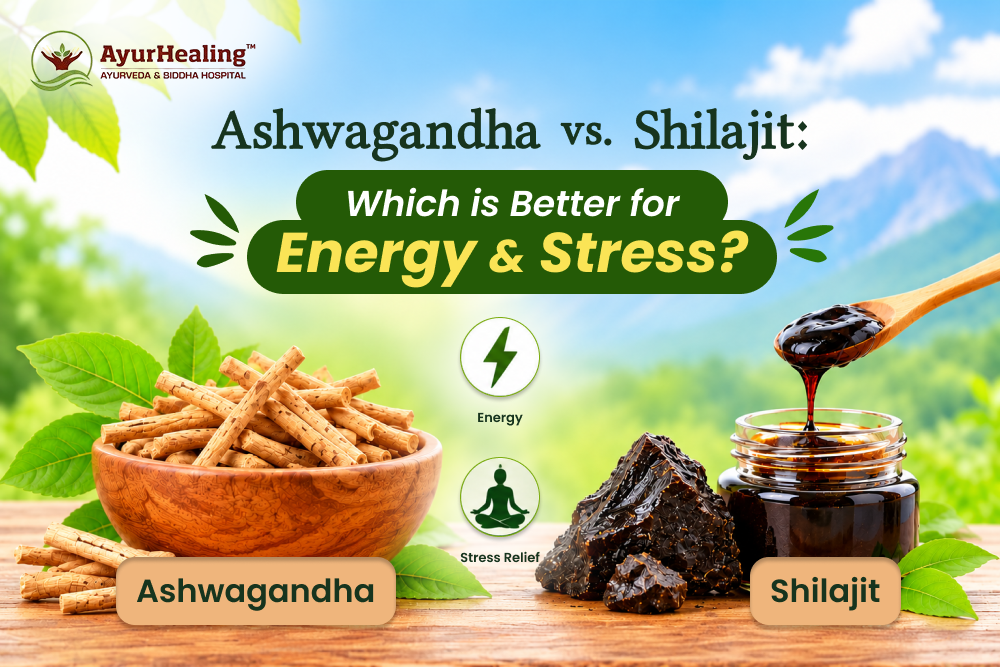
Is Ashwagandha or Shilajit Better for Energy and Stress?
Ashwagandha is generally the more relevant option to investigate when stress management and sleep are the primary concerns, as some human studies suggest that specific Ashwagandha extracts may help reduce perceived stress and improve sleep.
Shilajit is traditionally associated with vitality and physical strength, but reliable human evidence supporting its effectiveness for increasing energy and stamina remains limited.
Neither supplement is suitable for everyone. The right choice depends on individual health conditions, medications, lifestyle and professional advice. Neither should replace medical treatment or healthy daily habits.
What Is Ashwagandha? Understanding Its Ayurvedic Uses
Ashwagandha, scientifically known as Withania somnifera, is a medicinal plant traditionally used in Ayurveda. Its roots are commonly used in Ayurvedic preparations and are associated with supporting strength, vitality and the body’s ability to cope with everyday physical and mental challenges.
In traditional Ayurvedic practice, Ashwagandha is often discussed as a Rasayana, a category of preparations associated with nourishment, rejuvenation and maintaining overall well-being.
How is Ashwagandha traditionally used?
Ashwagandha is commonly explored in traditional wellness practices for:
- Supporting relaxation and emotional balance.
- Maintaining general strength and vitality.
- Supporting restful sleep.
- Helping the body cope with everyday stress.
- Supporting recovery and general well-being.
Its growing popularity is also connected to research on withanolides, naturally occurring compounds found in the plant.
What does scientific research say about Ashwagandha?
There is some encouraging human research, particularly concerning stress and sleep.
The US National Institutes of Health (NIH) Office of Dietary Supplements reports that several clinical trials have found improvements in perceived stress, anxiety symptoms and sleep among participants using certain Ashwagandha extracts. However, the studies differ in their formulations, doses and duration, making it difficult to establish universal recommendations.
Most studies have been relatively short, often lasting between six and twelve weeks. More research is needed to understand its long-term effects.
This means Ashwagandha is worth discussing as a potential complementary wellness option, but it should not be considered a proven treatment for anxiety disorders or chronic fatigue.
What Is Shilajit? Exploring Its Traditional Role
Shilajit is a naturally occurring, dark-coloured mineral-rich substance found in mountainous rock formations, including parts of the Himalayas. It develops over long periods through the decomposition of organic material and contains various minerals and organic compounds.
In Ayurveda, Shilajit is traditionally regarded as a Rasayana and is associated with vitality, strength and physical endurance.
Unlike Ashwagandha, which comes from a plant, Shilajit is a complex natural substance with a different composition.
What are the traditional uses of Shilajit?
Shilajit has traditionally been used in Ayurvedic preparations associated with:
- Supporting general vitality.
- Maintaining physical strength.
- Promoting overall nourishment.
- Supporting healthy ageing.
- Maintaining general physical well-being.
Its composition can vary depending on its geographical origin, processing and purification.
Does Shilajit really improve energy?
Shilajit is frequently marketed as a natural energy booster. Some preliminary studies have explored its possible effects on physical performance and other health-related outcomes.
However, the available human research is limited. The US Department of Defense’s Operation Supplement Safety (OPSS) notes that there is little reliable evidence supporting claims that Shilajit improves energy, stamina, endurance or mental performance.
Therefore, its traditional reputation should not be confused with established clinical effectiveness.
Ashwagandha vs. Shilajit: What Are the Main Differences?
Although both ingredients are popular in Ayurvedic wellness discussions, they differ in their origins, traditional applications and available scientific evidence.
| Comparison | Ashwagandha | Shilajit |
| Origin | Medicinal plant | Natural mineral-rich substance |
| Scientific name | Withania somnifera | No single botanical species |
| Commonly studied compounds | Withanolides | Fulvic acid and other organic and mineral components |
| Traditional association | Strength, resilience and relaxation | Vitality, endurance and rejuvenation |
| Stress-related evidence | Some encouraging human studies | Insufficient reliable evidence |
| Energy-related evidence | Limited studies suggest possible fatigue-related benefits | Limited and preliminary |
| Common forms | Root powder, capsules and extracts | Purified resin, powder and capsules |
Which one is better for stress?
Ashwagandha has the stronger research background when it comes to perceived stress and sleep.
Some clinical studies have reported improvements in stress scores and reductions in cortisol levels. However, the results relate to particular preparations and study populations, not every commercially available supplement.
Shilajit has a traditional association with vitality, but there is insufficient high-quality human evidence to recommend it specifically for stress management.
Which one is better for physical energy?
The answer is less straightforward.
Ashwagandha has been investigated in studies involving fatigue and physical well-being. Some findings suggest potential benefits, but they do not establish it as a general energy treatment.
Shilajit has also been investigated for physical performance, but the evidence is not strong enough to support the widespread claims made in supplement marketing.
If tiredness is persistent, identifying its underlying cause is more important than immediately choosing an energy supplement.
How Do These Herbs Fit Into an Ayurvedic Approach to Stress Management?
Ayurveda traditionally considers well-being through a combination of physical health, mental balance, digestion, sleep and daily routines.
From this perspective, stress is not necessarily addressed by introducing a single herb. A broader approach may consider a person’s lifestyle, eating habits, sleep quality, daily responsibilities and individual health requirements.
An Ayurvedic Treatment for Stress may involve a personalised combination of traditional dietary guidance, appropriate daily routines, relaxation practices and other interventions selected by a qualified practitioner.
Can Ashwagandha replace stress-management practices?
No. Even when an individual may benefit from a suitable Ashwagandha preparation, it should not replace healthy lifestyle practices or professional mental healthcare.
Consider these everyday habits:
- Maintain consistent sleep: Follow a regular sleeping and waking schedule.
- Eat balanced meals: Include vegetables, fruits, whole grains and suitable protein sources.
- Stay physically active: Choose walking, yoga or other activities appropriate for your health.
- Practise relaxation: Breathing exercises and meditation may help manage everyday stress.
- Take regular breaks: Avoid extended periods of uninterrupted work.
For people experiencing persistent anxiety, panic symptoms or significant emotional distress, professional medical assessment is important.
A Simple Decision Guide: Should You Consider Ashwagandha or Shilajit?
Choosing between supplements becomes easier when you start with your actual health concern instead of the popularity of an ingredient.
The following decision structure can help readers understand what to consider before making a choice.
Ashwagandha vs. Shilajit: A Wellness Decision Guide
START: What is your main concern?
Identify the reason you are considering a supplement
Stress or poor sleep
Explore whether Ashwagandha is appropriate. Some specific extracts have encouraging short-term research.
Low physical energy
Investigate the cause of fatigue. Shilajit’s energy claims are not well established.
NEXT: Review your health circumstances
Medical history, medications, pregnancy status, existing conditions and supplement quality
CONSULT A QUALIFIED HEALTHCARE PROFESSIONAL
Discuss suitability, possible interactions and appropriate monitoring
MAKE AN INFORMED DECISION
Choose a safe, individualised approach rather than self-prescribing
This guide is educational, not a diagnostic tool or a recommendation to start either supplement.
What Safety Precautions Should You Know Before Taking These Supplements?
Natural ingredients are not automatically safe for everyone. Their effects can depend on preparation, quality, quantity, individual health conditions and medication use.
Ashwagandha safety considerations
According to the NIH Office of Dietary Supplements, Ashwagandha appears to be generally tolerated in studies lasting up to approximately three months. However, its long-term safety is not established.
Possible side effects include:
- Stomach discomfort.
- Nausea and loose stools.
- Drowsiness.
- Rare reports of liver injury.
It may also affect thyroid function and interact with medicines used for diabetes, high blood pressure, seizures and immune-related conditions, as well as sedatives and thyroid medication.
Pregnant and breastfeeding women should avoid using it unless specifically advised by an appropriate healthcare professional. People with thyroid disorders, autoimmune conditions or liver problems should seek medical advice before considering it.
Shilajit safety considerations
Shilajit requires particular attention to sourcing and purification.
Unprocessed or poorly processed Shilajit may contain heavy metals, including lead, arsenic, mercury and cadmium. The amount and composition can vary between products.
Before considering a Shilajit supplement:
- Check whether it is properly purified and processed.
- Look for credible independent laboratory testing.
- Check for heavy-metal testing and a certificate of analysis.
- Avoid products making unrealistic claims about instant energy or guaranteed results.
- Discuss its suitability with a qualified healthcare professional.
A product’s natural origin does not guarantee its purity or safety.
Can Ayurveda Offer More Than Herbal Supplements for Overall Wellness?
One of the important principles of traditional Ayurveda is that health is not approached through a single ingredient or preparation alone.
Depending on an individual’s needs, a qualified practitioner may consider different aspects of health and recommend suitable interventions.
For example, wellness concerns involving physical discomfort, stress or reduced mobility may require different assessments and approaches.
- Ayurvedic Treatment for Spine Health: People experiencing back discomfort or mobility-related concerns may benefit from an appropriate assessment and a treatment plan based on their condition.
- Ayurvedic Treatment for Panchakarma: Panchakarma refers to a group of traditional Ayurvedic procedures. These require proper assessment, preparation and professional supervision rather than being treated as a general detox programme.
- Ayurvedic Treatment for Joint Care: Joint discomfort and stiffness need an individual assessment to understand possible causes and appropriate care.
- Ayurvedic Treatment for Piles: Rectal bleeding, pain and discomfort should be medically evaluated. Traditional treatment options should only be considered after an appropriate diagnosis.
- Ayurvedic Treatment for Stroke: Stroke is a medical emergency. Immediate hospital treatment and evidence-based rehabilitation are essential. Ayurveda must never replace emergency care or prescribed stroke treatment.
These examples demonstrate why individual assessment matters more than choosing a popular herb based on general claims.
How Can You Choose an Ayurvedic Hospital in Bangalore for Personalised Guidance?
When exploring traditional healthcare options, choosing the right healthcare provider is an important step.
If you are considering Ashwagandha, Shilajit or other Ayurvedic preparations, professional guidance can help you understand whether they are appropriate for your circumstances.
When looking for an Ayurvedic Hospital in Bangalore, consider the following factors:
- Qualified practitioners: Check the practitioner’s recognised qualifications, registration and relevant experience.
- Individual assessment: Your health history, symptoms, lifestyle and current medication should be considered.
- Treatment transparency: Ask about the purpose, possible risks and expected outcomes of any recommended preparation or procedure.
- Medicine quality: Understand the source, ingredients, manufacturing standards and testing of prescribed products.
- Appropriate medical referrals: A responsible healthcare provider should recognise when conventional medical investigation or specialist care is necessary.
At Ayurhealing, our approach to Ayurveda focuses on personalised care and understanding individual wellness requirements.
Located in Koramangala, Ayurhealing provides Ayurvedic and Siddha healthcare under the guidance of Dr. Mini Nair. People exploring traditional approaches to well-being can learn more about the hospital and its healthcare approach at Ayurhealing.
Why Is Personalised Ayurvedic Guidance Important?
Two people experiencing similar symptoms may have very different health requirements. One person may struggle with poor sleep and work-related stress, while another may experience persistent fatigue because of nutritional deficiencies, hormonal changes or an underlying medical condition.
This is why selecting a supplement without understanding the cause of the problem can be misleading.
A personalised consultation can help evaluate:
- Existing health conditions and medical history.
- Dietary habits and digestive health.
- Sleep patterns and stress levels.
- Current medications and possible interactions.
- Whether an Ayurvedic preparation is suitable.
- Whether additional medical investigations are required.
For individuals looking for an Ayurvedic Hospital in Bangalore, prioritising qualified guidance, treatment transparency and appropriate medical referrals is more important than choosing a healthcare provider based on supplement recommendations alone.
Conclusion: Making the Right Choice for Energy and Stress
Ashwagandha and Shilajit have different traditional applications, compositions and levels of scientific evidence. Ashwagandha currently has more encouraging human research relating to stress and sleep, while Shilajit continues to attract interest for its traditional association with vitality and physical strength. However, neither should be treated as a guaranteed solution for fatigue or stress.
The better approach is to understand what your body needs, identify possible causes of your symptoms and seek appropriate professional guidance before starting supplements.
Healthy eating, consistent sleep, regular physical activity and effective stress-management practices remain important foundations of overall well-being.
At Ayurhealing, we believe that healthcare should consider individual needs rather than rely on one-size-fits-all solutions. If you are exploring traditional wellness approaches, consult a qualified practitioner and make informed decisions about your health. Contact Ayurhealing.