In the vast and beautifully structured world of Ayurvedic healing, there exists a therapy so comprehensive, so deeply restorative, that ancient texts called it the very best of all Panchakarma procedures. That therapy is Basti treatment in Ayurveda. For thousands of years, Ayurvedic physicians have relied on Basti – a precisely administered medicated enema therapy – to cleanse the colon, correct Vata imbalances, eliminate deep-seated toxins, and restore the body’s natural rhythms. And yet, despite its extraordinary therapeutic range, Basti remains one of the least understood Panchakarma therapies outside Ayurvedic circles.
If the word “enema” makes you hesitant, you are not alone. Most people’s reference point for enemas is the uncomfortable, clinical procedure used in hospitals – nothing like what Basti represents. Ayurvedic Basti is a deeply nourishing, carefully personalised, medically supervised therapy that uses warm herbal oils, decoctions, and ghee to heal far beyond the colon – reaching joints, nerves, muscles, hormonal systems, and even the mind.
At Ayurhealing, we have seen Basti transform patients who had exhausted every other option – from chronic back pain and arthritis to stubborn constipation and hormonal imbalances. This blog is our attempt to give you the full, honest picture of what Basti is, how it works, who truly benefits from it, and why it continues to stand as the gold standard of Ayurvedic detoxification.
What Is Basti Treatment in Ayurveda? Understanding the Basics
The word “Basti” in Sanskrit literally means “bladder” – referring to the traditional animal bladder instrument once used to administer the therapy. Today, sterile medical-grade equipment is used, but the classical protocols remain unchanged. Basti Panchakarma therapy involves administering medicated substances – herbal decoctions (Kashaya), medicated oils (Sneha), ghee, milk, or a combination of these – through the rectal route to cleanse, nourish, and rebalance the lower gastrointestinal tract and the entire Vata dosha system.
In Ayurveda, the colon (Pakwashaya) is considered the primary seat of Vata dosha – the energy governing all movement, nerve conduction, circulation, elimination, and even thought. When Vata becomes aggravated or imbalanced, it causes a cascade of health problems throughout the body: pain, stiffness, anxiety, constipation, dryness, irregular digestion, and poor sleep, to name just a few.
Basti works directly at the root of this imbalance. By administering therapeutic substances through the colon, Basti simultaneously detoxifies, lubricates, nourishes, and rebalances – making it one of the most multidimensional healing interventions in all of Ayurvedic medicine.
Key reasons Basti is considered the most important of the five Panchakarma therapies:
- It directly addresses Vata dosha – the dosha most responsible for chronic disease and premature ageing
- The rectal mucosa absorbs herbal compounds rapidly and efficiently, allowing healing substances to reach deep tissues
- It acts on the enteric nervous system – the gut’s own “second brain” – producing systemic neurological and hormonal effects
- It can be customised comprehensively for dozens of different conditions through variations in herbal formulations
- Its effects are lasting – not just symptomatic relief, but genuine constitutional rebalancing
Types of Basti in Ayurveda – Not All Basti Is the Same
One of the most important things to understand about Basti is that it is not a single, uniform procedure. Classical Ayurvedic texts describe multiple types of Basti, each designed for a specific therapeutic purpose. Your Ayurvedic physician will select the appropriate type – or a combination – based on your constitution, current condition, and treatment goals.
1. Niruha Basti (Asthapana Basti) – The Cleansing Enema
Niruha Basti uses a water-based herbal decoction combined with honey, rock salt, medicated oils, and herbal pastes. It is primarily a cleansing and detoxifying Basti – designed to remove accumulated Ama (toxins), expelled Vata, and metabolic waste from the colon and deeper tissues. It is particularly effective for conditions characterised by accumulation, heaviness, and systemic toxin overload. Niruha Basti is typically retained in the body for a short period before being expelled, carrying toxins with it.
2. Anuvasana Basti- The Nourishing Enema
Anuvasana Basti uses warm medicated oils or ghee administered in smaller quantities. Unlike Niruha, this type nourishes, lubricates, and rejuvenates the colon and deeper tissues, and is safely retained for longer periods to allow deep tissue absorption. It is especially valuable for Vata-type conditions involving dryness, depletion, weakness, and emaciation. Anuvasana Basti is generally gentler and suitable for regular use over a treatment course.
3. Kati Basti – Localised Oil Retention for the Lower Back
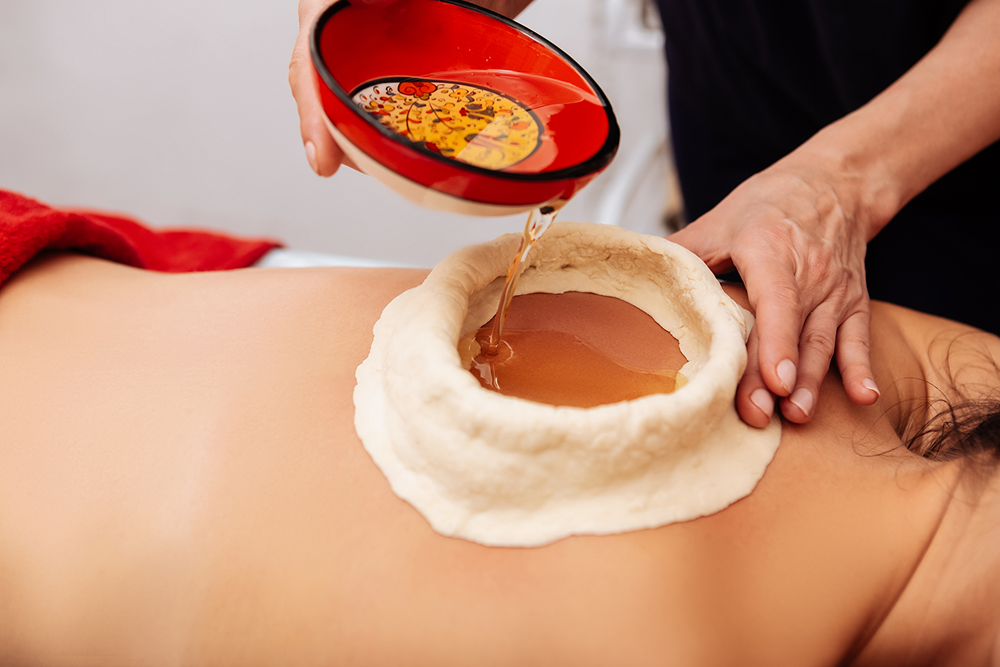
Kati Basti treatment is a specialised external therapy where warm medicated oil is retained over the lower back (lumbar region) using a ring made of herbal dough. Though it shares the “Basti” name, this is a topical procedure rather than an internal enema. It is one of the most effective Ayurvedic treatments for chronic low back pain, lumbar disc herniation, sciatica, and sacral stiffness. The sustained heat and deep penetration of medicated oil into the paraspinal muscles and lumbar vertebrae bring remarkable, lasting relief that most patients describe as transformative.
4. Uttara Basti – Reproductive and Urinary Health
Uttara Basti is administered through the urinary or reproductive tract and is used specifically for conditions affecting the urogenital system – including infertility, PCOS, uterine disorders, urinary tract infections, and semen quality issues in men. This highly specialised form must be performed by a trained Ayurvedic physician and is an integral part of fertility-focused Ayurvedic treatment programmes.
5. Matra Basti – The Daily Maintenance Basti
Matra Basti uses a small, fixed quantity of medicated oil and can be administered daily as a maintenance and rejuvenation therapy. It is safe for regular use, does not require prior oleation or special preparation, and is suitable for those who need ongoing Vata pacification – such as the elderly, those with chronic degenerative conditions, or highly active individuals whose Vata is perpetually elevated by lifestyle.
The choice of which type to use – and in what sequence – is one of the most nuanced clinical decisions in Ayurvedic practice. This is precisely why self-administering Basti is strongly discouraged. The personalisation, preparation, and post-procedure management are what make Basti safe and effective.
The Key Benefits of Basti Treatment in Ayurveda
The therapeutic scope of Panchakarma Basti therapy is broader than almost any other single Ayurvedic intervention. Here is a detailed look at the most significant and well-documented benefits:
Basti Treatment for Back Pain and Musculoskeletal Disorders
One of the most powerful applications of Basti is in the treatment of musculoskeletal conditions. Basti treatment for back pain – particularly in combination with Kati Basti – addresses not just the pain itself but the underlying Vata aggravation and tissue depletion driving the chronic discomfort. Conditions that respond exceptionally well include:
- Chronic low back pain and lumbar disc herniation
- Sciatica and radiating leg pain
- Cervical spondylosis and neck stiffness
- Osteoarthritis and degenerative joint disease
- Basti Ayurveda for arthritis – both rheumatoid and osteoarthritis types
- Muscle stiffness, cramps, and spasms
- Fibromyalgia and chronic widespread pain
Patients who have lived with chronic back pain for years – often through cycles of painkillers, physiotherapy, and temporary relief – frequently report that a course of Basti therapy produces the most significant and lasting improvement they have ever experienced.
Basti Treatment for Constipation and Digestive Disorders
The colon is Basti’s primary domain, making it the most direct and effective Ayurvedic intervention for digestive concerns. Basti treatment for constipation goes far beyond simply clearing the bowels – it retrains the colon, restores healthy peristalsis, replenishes the intestinal mucosa, and corrects the Vata imbalance that makes chronic constipation so resistant to ordinary remedies. Digestive conditions that benefit significantly include:
- Chronic constipation – including cases where laxatives have become dependency-forming
- Irritable Bowel Syndrome (IBS) with constipation or alternating patterns
- Bloating, gas, and abdominal distension
- Inflammatory Bowel Disease (IBD) – Crohn’s disease and ulcerative colitis
- Haemorrhoids (Arsha) and anal fissures
- Malabsorption syndromes and nutritional deficiencies linked to poor gut function
Basti for Vata Dosha – Healing the Root of Most Chronic Disease
In Ayurveda, uncontrolled or aggravated Vata is the ultimate driver of most chronic diseases. Basti for Vata dosha correction is therefore not just a treatment for specific conditions – it is a fundamental act of prevention and constitutional rebalancing. When Vata is properly pacified through Basti, the ripple effects touch every system of the body:
- The nervous system calms – anxiety, restlessness, and insomnia improve
- Circulation improves – cold extremities, poor wound healing, and cardiovascular irregularities correct
- The immune system strengthens – chronic infections and autoimmune flares reduce in frequency
- Hormonal regulation improves, particularly thyroid, adrenal, and reproductive hormones
- Cognitive clarity returns – brain fog, poor memory, and concentration difficulties ease
- Skin quality improves – dryness, premature wrinkling, and hair fall reduce
This is what makes Basti so uniquely powerful – it does not just treat symptoms; it addresses the foundational energy imbalance from which most chronic conditions in the modern world arise.
Additional Conditions Treated by Basti Therapy
Beyond the major categories above, clinical Ayurvedic practice has documented Basti’s effectiveness across a wide range of conditions:
- Neurological disorders – Parkinson’s disease, motor neuron conditions, and peripheral neuropathy
- Infertility and reproductive health – both male and female
- Obesity and metabolic disorders
- Skin conditions – psoriasis, eczema, and chronic urticaria linked to Vata imbalance
- Anti-ageing and rejuvenation – Basti is a primary Rasayana therapy in Ayurveda
- Post-surgical recovery and rehabilitation – to rebuild depleted tissues
- Diabetes management – improving insulin sensitivity and reducing neuropathic complications
What to Expect During a Basti Treatment Session
For patients new to Basti, understanding what the process involves helps ease any apprehension and prepares them to get the most from the therapy. Here is a step-by-step overview of what a typical Basti session at a quality Ayurvedic clinic looks like:
- Pre-treatment preparation (Purvakarma): Before Basti can be administered, the body is typically prepared through a period of internal oleation (Snehapana – consuming medicated ghee) and external oil massage (Abhyanga), followed by steam therapy (Swedana). This softens and loosens deep-seated toxins, making them available for elimination through the Basti.
- Preparation of the Basti formulation: Your physician prescribes the exact herbal formulation for your condition. The decoctions and oils are freshly prepared, warmed to body temperature, and carefully combined according to the classical ratios described in Ayurvedic texts.
- Administration: You lie comfortably on your side on a treatment table. The medicated preparation is gently administered through the rectum using a sterile, graduated enema syringe. The process is quick – usually completed within a few minutes – and should cause no pain when performed by a trained therapist.
- Retention and release: For Niruha Basti, you retain the preparation for a short period before releasing it. For Anuvasana Basti, retention is longer to allow deep tissue absorption. Your therapist will guide you through this phase.
- Rest and post-treatment care: After the session, you rest in a warm, quiet environment. Warm herbal teas may be offered. You will be given specific dietary and lifestyle guidance for the remainder of the day – avoiding cold food, raw foods, and strenuous activity.
Who Should Consider Basti Treatment – and Who Should Avoid It?
Basti is appropriate for a wide range of individuals across age groups. You may be an ideal candidate if you:
- Experience chronic joint pain, back pain, or stiffness that has not fully responded to other treatments
- Struggle with long-term constipation, IBS, or sluggish digestion
- Have been diagnosed with a Vata-predominant condition by an Ayurvedic physician
- Are undergoing a full Panchakarma detox programme
- Are you managing a neurological condition or recovering from a degenerative disease
- Are you seeking natural support for fertility, hormonal balance, or reproductive health
- Want to undergo a deep Ayurvedic detox treatment in Bangalore as preventive care
Basti is generally contraindicated for:
- Pregnant women
- Patients with active rectal bleeding or recent rectal surgery
- Those with acute diarrhoea or dysentery
- Patients with intestinal perforation or active inflammatory bowel flare
- Children under seven years of age
- Those who have recently undergone fasting without proper oleation preparation
A thorough pre-treatment consultation with a qualified Ayurvedic physician is always required before beginning any Basti programme. The assessment includes pulse diagnosis, constitution evaluation, and a review of your current medications and health history.
Basti and Panchakarma Treatment in Bangalore – What to Look For
Bangalore has emerged as one of India’s most active cities for authentic Ayurvedic care, with a growing number of patients seeking Panchakarma treatment in Bangalore as a serious medical intervention – not just a wellness experience. When looking for a clinic to receive Basti, the standard of medical supervision, the authenticity of herbal preparations, and the thoroughness of the pre- and post-treatment care are everything.
At Ayurhealing, we offer the best Ayurvedic treatment in Bangalore, drawing from the deep classical traditions of both mainstream Ayurveda and the refined healing legacy of Kerala. As a trusted Ayurveda and Siddha hospital, our approach integrates:
- In-depth initial consultation with Nadi Pariksha (pulse diagnosis) by our senior physicians
- Customised Basti formulations prepared in-house using quality-tested, authentic herbs
- A fully supervised Panchakarma programme with daily progress review
- Personalised dietary and lifestyle guidance throughout the treatment
- Integration with other Panchakarma therapies – Abhyanga, Swedana, Virechana, and Nasyam – when clinically indicated
- Detailed post-treatment follow-up to consolidate results and prevent recurrence
Whether you are searching for the best Ayurvedic doctor in Bangalore for a specific condition or are simply ready to invest in your long-term health through authentic Panchakarma, our team at Ayurhealing is here to guide you with honesty, expertise, and genuine care.
Final Thoughts: The Most Complete Healing Therapy Ayurveda Has to Offer
Basti is not simply an enema. It is a doorway into the body’s deepest systems – a therapy that reaches where most medicines cannot, corrects what most treatments overlook, and heals in ways that last. The ancient Ayurvedic masters did not call it the king of Panchakarma therapies without reason. After thousands of years and millions of patients, Basti continues to prove that wisdom.
If you have been living with a condition that has resisted every other approach – or if you want to reset your body with the most comprehensive Ayurvedic detox available – Basti treatment in Ayurveda may be the turning point you have been waiting for.
At Ayurhealing, we invite you to take the first step. Book a consultation with our Ayurvedic physicians today, and let us design a Basti programme that meets your body exactly where it is – and helps it become everything it is meant to be.